Q1. In a right-angled triangle, the measure of ____________ angle/angles is 90o.
Solution
In a right-angled triangle, only one angle is of measure 90o.
Q2. A triangle has ____________ components.
Solution
6 components - three angles and three sides
Q3. In a triangle, base is given and 2 adjacent angles are of more than 90 degrees. Is it possible to construct such a triangle?
Solution
Draw a line AB of a particular length between points A and B.
Let A be a left sided point.
Draw a line of 90 degree angle at point A. It will go vertical.
Similarly, Draw a line of 90 degree angle at point B. It will also go vertical.
Hence, these 2 new lines can never meet. And if these angles are more than 90 degree then also, they can never meet.
Hence, answer is option B.
Alternatively, triangle property is that the sum of the 3 angles can't be more than 180 degrees. In this problem, sum of 2 angles is more than 180 degree (each being more than 90 degree) and hence exceeds 180 degree. Hence, this triangle is not possible.
Q4. Identify the triangle which cannot be constructed:
-
1)

-
2)

-
3)

-
4)

Solution
Since, the angle sum of a triangle is 180o, triangle ABC cannot be constructed because the angle sum exceeds 180o.
115o + 85o + m C = 200o + mC > 180o
C = 200o + mC > 180o
Q5. Given BC = 5 cm, AC = 5.5 cm. Which of the following part is required to construct triangle ABC?
-
1)
 B
B
- 2) None of the above
-
3) A
-
4) C
Solution
A triangle can be constructed if two sides and the included angle are given.
The angle included between BC and AC is C, hence the answer.
C, hence the answer.
Q6. Given  P = 70o and Q = 115o. Which of the following part is required to construct triangle PQR?
P = 70o and Q = 115o. Which of the following part is required to construct triangle PQR?- 1) RP
- 2) QR
- 3) PQ
-
4)
 R
R
Solution

Q7. See the figure below:
 To draw a line parallel to l through A, the next step will be:
To draw a line parallel to l through A, the next step will be:Solution
Join AH.

Q8. Draw an equilateral triangle measure of each of its side is 4 cm.
Solution
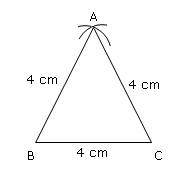 Steps of construction: 1. Draw a line segment BC = 4 cm. 2. Taking B as a centre and radius 4 cm, draw an arc above BC. 3. With same radius and centre C, draw an arc which cut the previous arc at A. 4. Join AB and AC. 5. Hence ABC is the required triangle.
Q9. The steps of construction of an isosceles triangle PQR with angle PQR as 110o are as follows:
(i) Draw the base QR.
(ii) Join P to R to obtain the required triangle PQR.
(iii) At point Q, draw a ray QX making an angle 110° with QR.
(iv) Taking Q as centre, draw an arc of radius equal to QR. It intersects QX at the point P.
The correct order of steps is
Solution
The steps of construction in order are:
(i) Draw the base QR.
(ii) At point Q, draw a ray QX making an angle 110° with QR.
(iii) Taking Q as centre, draw an arc of radius equal to QR. It intersects QX at the point P.
(iv) Join P to R to obtain the required triangle PQR.
Q10. Draw a right angle triangle right angled at A and AB = 6 cm, BC = 10 cm.
Solution
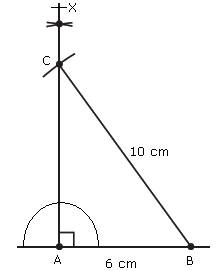 Steps of construction: 1. Draw a line segment AB = 6 cm and extend it in both directions. 2. Draw AX perpendicular AB. 3. Cut BC = 10 cm from B on AX. 4. Join BC. 5. Hence ABC is the required triangle.
Q11. Construct a triangle ABC such that AB = 5 cm, BC = 6 cm and AC = 7 cm.
Solution
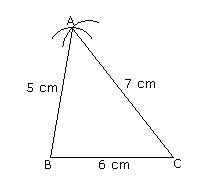 Steps of construction: 1. Draw a line segment BC = 6 cm. 2. Taking B as centre and radius 5 cm draw an arc. 3. Taking C as centre and radius 7 cm, draw an arc which cut the previous arc at A. 4. Join AB and AC. 5. Thus, ABC is the required triangle.
Q12. Draw a triangle ABC, where AB = AC = 4 cm and  B = 40o. Find C.
B = 40o. Find C.Solution
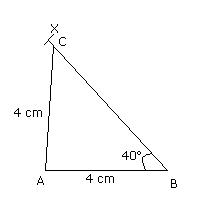 Steps of construction: 1. Draw a line segment AB = 4 cm. 2. Draw an angle of 40 degrees at B. 3. From A cut the line BX at 4 cm. 4. Join AC. 5. Thus, ABC is the required triangle. 6. After measuring, Angle C is 40 degrees.
Q13. Arav was asked to construct a triangle ABC with sides AB and BC equal to 5 cm and 6.5 cm respectively. The measure of the angle B is 600. He started the construction, which of the following steps of construction followed by him is incorrect
Solution
Since the measure of angle B is 600, he should have drawn angle 600 at point B and not at C.
Q14. Draw a triangle PQR, where PQ = 5.7 cm,  P = 45o and Q = 30o.
P = 45o and Q = 30o.Solution
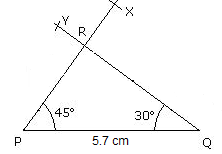 Steps of construction: 1. Draw a line segment PQ = 5.7 cm. 2. Draw an angle of 45o at P and 30o at Q and let them interest at R. 3. Thus, PQR is the required triangle.
Q15. Look at the figure below:
 To draw a line parallel to l through A, the first step will be:
To draw a line parallel to l through A, the first step will be:Solution
Join A to B.

Q16. Draw an angle ABC of 60o such that BC = 3 cm, through C draw a line parallel to AB.
Solution
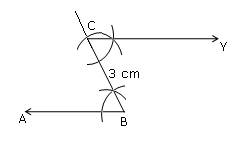 Steps of construction: 1. Draw an angle ABC of 60o. 2. Cut BC = 3 cm. 3. Through C, draw a line parallel to AB by making an angle of 60o on BC, as shown. 4. Hence, CY is parallel to AB.
Q17. Draw a line l, take a point A above it. Construct a line through A and parallel to l.
Solution
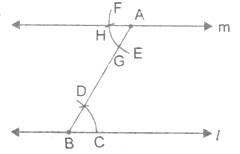 Steps of constructions: 1. Draw a line l of any length and take a point A above it. 2. Take any point B on l and join AB. 3. Taking B as a centre and any small radius draw an arc CD. 4. With same radius and A as a center draw an arc EF which cut AB at G. 5. Measure the arc CD using compass and with same measure cut the arc EF from G to H. 6. Join the points AH and extend in both the directions, name this line as m. 7. m is the required parallel line.
Q18. Construct triangle ABC, in which  A = 100o and B = 20o and CA = 5.4 cm.
A = 100o and B = 20o and CA = 5.4 cm.Solution
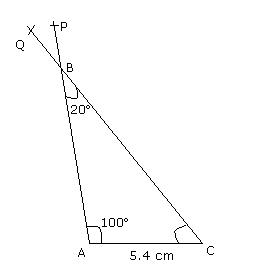 Steps of construction: 1. Draw the line segment AC = 5.4 cm. 2. Draw an angle of 100o at A. 3. Since, Angle C = 180o - (100o + 20o) = 60o. So draw an angle of 60o at C. 4. Let the line AP and CQ meet at B. 5. Thus, ABC is the required triangle.
Q19. Construct a right triangle XYZ in which  Y = 90o, XZ = 6 cm and YZ = 4 cm.
Y = 90o, XZ = 6 cm and YZ = 4 cm.Solution
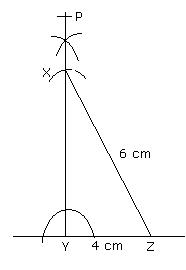 Steps of construction: 1. Draw a line segment YZ = 4 cm and extend it in both directions. 2. Draw YP perpendicular to YZ. 3. Cut ZX = 6 cm from Z on YP. 4. Join ZX. 5. Hence, XYZ is the required triangle.
Q20. Draw a line segment AB = 6 cm. Draw a line CD parallel to AB such that distance between AB and CD is 5 cm.
Solution
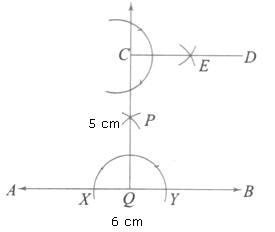 Steps of constructions: 1. Draw a line AB = 6 cm, take any point Q on it. 2. Taking Q as a center draw an arc XY. 3. Taking same radius draw two arcs from X and Y and let them intersect at P. 4. Join QP and extend. 5. On QP, take a point C such that QC = 5 cm. 6. Again from C, draw a perpendicular line CD. 7. Hence CD is parallel to AB.
Q21. Construct an isosceles right triangle PQR in which  R = 90o and PR = QR = 5 cm.
R = 90o and PR = QR = 5 cm.Solution
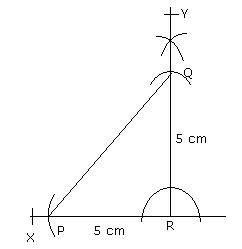 Steps of construction: 1. Draw a line RX and RY such that RY is perpendicular on RX. 2. Taking radius 5 cm and centre R cut the lines RX and RQ at P and Q respectively. 3. Join PQ. 4. PQR is the required triangle.
Q22. Draw a line AB and then construct another line parallel to AB which is 4 cm above it.
Solution
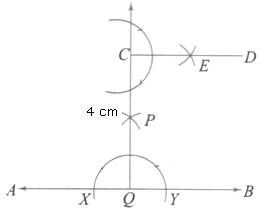 Steps of constructions: 1. Draw a line AB, take any point Q on it. 2. Taking Q as a center draw an arc XY. 3. Taking same radius draw two arcs from X and Y and let them intersect at P. 4. Join QP and extend. 5. On QP, take a point C such that QC = 4 cm. 6. Again from C, draw a perpendicular line CD. 7. Hence CD is parallel to AB.
Q23. In the following parallelogram, draw a line through C parallel to BD. 
Solution
We draw the line parallel to BD through C by using ruler and compass as shown below: 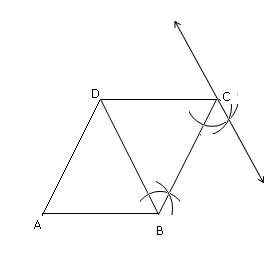
Comments
Post a Comment