Q1. If  then angle A is a/an _______ angle.
then angle A is a/an _______ angle.Solution
An angle whose measure is greater than 90° and less than 180° is called an obtuse angle.
Q2. In the following figure, angle 1 and 5 are:

Solution
Angles 1 and 5 are corresponding angles.
Q3.
Line FB is parallel to Line EC.
Use properties of angles to find 'y' :
Solution
We know that, Line FB is parallel to Line EC.
Here we can clearly see that,
 AOF and CPD are equal alternate exterior angles. Thus, AOF = CPD So, 114 = 2y 2y = 114 (transposing both sides of equation) y =
  (dividing both sides by 2) i.e., y = 57o
AOF and CPD are equal alternate exterior angles. Thus, AOF = CPD So, 114 = 2y 2y = 114 (transposing both sides of equation) y = (dividing both sides by 2) i.e., y = 57o
Q4. 
-
1)

-
2)

-
3)

-
4)

Solution

Q5. The reflex angle of 60 is ______ .
is ______ .Solution
The reflex angle of 60 is 360o - 60o = 300o
Q6. Complementary angle of 55o is
Solution
Complementary angle of 55o is 90o- 55o= 35o.
Q7. In the adjoining figure, the measure of angle a is 50o, what is the measure of angle b?
Solution
Angle d forms a linear pair with Angle 72o
Thus, d = 180o - 72o = 108o
Now, a + b and d are opposite angles
so, a + b = d
b = d - b
b = 108° - 50°
b = 58°
Q8. In the figure given below, the measure of y is:

Solution
Since, the angle measuring 150o and y are corresponding angles. Therefore, y = 150o.
(As the lines are parallel, corresponding angles are equal)
Q9. Which of the following relations is correct for the given figure?

Solution
The line segment QR is less than the ray RS which is further less than the line PS.
Q10. In the following figure, the measure of angle x is

Solution
When two lines intersect each other, the opposite angles formed are equal.
Hence, x = 35°
Q11. Find the values of angles y and z in the following figure :
Solution
In the given figure we can see that,  AOE = COD [vertically opposite angles] So, COD = z = 43o Since AOB, BOC, COD are linear pair of angles, thus AOB + BOC + COD = 180o BOC + COD = 90o + 43o = 133o Thus, AOB = y = 180o - 133o = 47o Thus, y = 47o and z = 43o
AOE = COD [vertically opposite angles] So, COD = z = 43o Since AOB, BOC, COD are linear pair of angles, thus AOB + BOC + COD = 180o BOC + COD = 90o + 43o = 133o Thus, AOB = y = 180o - 133o = 47o Thus, y = 47o and z = 43o
Q12. Name the different types of angles. Draw an acute angle and obtuse angle of any measure.
Solution
The different types of angles are : (i) Right angle (90o) (ii) Acute angle (< 90o) (iii) Obtuse angle (>90o) (iv) Linear angle (180o) (v) Reflex angle (> 180o) (vi) Complete angle (360o) Acute angles are those angles which measure less than 90o and obtuse angles have a measure greater than 90o. 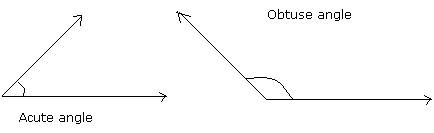
Q13. What is the measure of complement of each of the following angle? (a) 45o (b) 54o (c) 65o
Solution
To find the complement of each of the given angle, we have to subtract them from 90o, since the sum of two complementary angles is 90o. (a) 45o Complementary angle of 45o = 90o - 45o = 45o (b) 54o Complementary angle of 54o = 90o - 54o = 36o (c) 65o Complementary angle of 65o = 90o - 65o = 25o
Q14. Identify which of the following pairs are complementary and which are supplementary. (a) 68o, 112o (b) 55o, 35o (c) 79o, 101o (d) 64o, 26o
Solution
In order to find the complementary pair of angles, add the angles to get 90o. And to find the supplementary pair, the angle sum should amount to 180o. (a) 68o, 112o Sum = 68o + 112o = 180o Thus, it is a supplementary pair of angles. (b) 55o, 35oSum = 55o + 35o = 90o
Thus, it is a complementary pair of angles. (c) 79o, 101o Sum = 79o + 101o = 180o Thus, it is a sumpplementary pair of angles.
(d) 64o, 26o Sum = 64o + 26o = 90o Thus, it is a complementary pair of angles.
Q15. In the adjoining figure the measure of angle x is ______ . 
Solution
x =  = 54°
= 54°
= 54°
Q16. Name all pairs of vertically opposite angles in the following figure, where WR and VS are parallel lines and PU and QT are the transversals. 
Solution
Given that, WR || VS ; Thus, the pair of vertically opposite angles are : (i)  WAP and BAC ; (ii) PAB and CAW ; (III) VCA and UCD ; (IV) ACD and VCU ; (V) QBR and ABD ; (VI) QBA and DBR ; (VII) BDS and CDT ; (VIII) TDS and BDC.
WAP and BAC ; (ii) PAB and CAW ; (III) VCA and UCD ; (IV) ACD and VCU ; (V) QBR and ABD ; (VI) QBA and DBR ; (VII) BDS and CDT ; (VIII) TDS and BDC.
Q17. What are vertically opposite angles? Illustrate.
Solution
When two lines intersect, the angles formed are called vertically opposite angles.  Here, the pairs of vertically opposite angles are :
  1 and 3 ; 2 and 4
Here, the pairs of vertically opposite angles are : 1 and 3 ; 2 and 4
Q18. Name all possible angles formed in the figure given below: 
Solution
Name an angle using the vertex and one point on each ray. The vertex is always the middle point. The angles that are formed in the figure are as follows:  AOP, POQ, QOR, ROB, AOQ, AOR, POR, POB, QOB and AOB (straight angle 180o)
AOP, POQ, QOR, ROB, AOQ, AOR, POR, POB, QOB and AOB (straight angle 180o)
Q19. In the figure below, AP is parallel to CD. The size w of angle PAB is equal to 135o and the size z of angle DCB is equal to 147o. Find angle ABC.

Solution
Draw BS parallel to AP and CD as shown in the figure below. 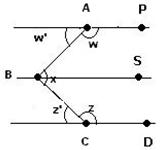
 ABC = ABS + CBS w' and ABS are alternate interior angles So, ABS = w' z' and CBS are alternate interior angles So, CBS = z' Angles w and w' are supplementary which gives w' = 180o - w = 180o - 135o = 45o Angles z and z' are also supplementary which gives z' = 180o - z = 180o - 147o = 33oTherefore, we have: ABC = ABS + CBS
ABC = w' + z' = 45o + 33o = 78o
ABC = ABS + CBS w' and ABS are alternate interior angles So, ABS = w' z' and CBS are alternate interior angles So, CBS = z' Angles w and w' are supplementary which gives w' = 180o - w = 180o - 135o = 45o Angles z and z' are also supplementary which gives z' = 180o - z = 180o - 147o = 33oTherefore, we have: ABC = ABS + CBS
ABC = w' + z' = 45o + 33o = 78o
ABC = ABS + CBS w' and ABS are alternate interior angles So, ABS = w' z' and CBS are alternate interior angles So, CBS = z' Angles w and w' are supplementary which gives w' = 180o - w = 180o - 135o = 45o Angles z and z' are also supplementary which gives z' = 180o - z = 180o - 147o = 33oTherefore, we have: ABC = ABS + CBS
ABC = w' + z' = 45o + 33o = 78o
Q20. What is the measure of supplement of each of the following angle? (a) 121o (b) 77o (c) 159o
Solution
To find the supplement of each of the given angle, we have to subtract them from 180o, since the sum of two supplementary angles is 180o. (a) 121o Supplementary angle of 121o = 180o - 121o = 59o (b) 77o Supplementary angle of 77o = 180o - 77o = 103o (c) 159o Supplementary angle of 159o = 180o - 159o = 21o
Q21. In the given figure, if BF||CE, find the value of x.
Solution
Given that BF||CE,
 OPE and FOP are co-interior angles and are supplementary.Thus,
  OPE + FOP = 180o i.e., 80o + FOP = 180o FOP = 100o Thus, x = 100o
OPE and FOP are co-interior angles and are supplementary.Thus, OPE + FOP = 180o i.e., 80o + FOP = 180o FOP = 100o Thus, x = 100o
Q22. In the figure given below, AL||EM. Find the measure of all the interior angles cut by the transversals PK and BN.
Solution
Given:-  ACQ = 80o and LDB = 112o We have to find:- QCD , ODC , OQC and DOQ QCD + ACQ = 180o (linear pair of angles) Thus, QCD = 180o - 80o = 100o ODC = LDB (pair of vertically opposite angles) LDB = 112o Thus, ODC = 112o ACQ = OQC (pair of alternate interior angles) ACQ = 80o Thus, OQC = 80o Now, DOQ + ODC = 180o (interior angles on the same side of the transversal are supplementary) DOQ + 112o = 180o Thus,DOQ = 68o
ACQ = 80o and LDB = 112o We have to find:- QCD , ODC , OQC and DOQ QCD + ACQ = 180o (linear pair of angles) Thus, QCD = 180o - 80o = 100o ODC = LDB (pair of vertically opposite angles) LDB = 112o Thus, ODC = 112o ACQ = OQC (pair of alternate interior angles) ACQ = 80o Thus, OQC = 80o Now, DOQ + ODC = 180o (interior angles on the same side of the transversal are supplementary) DOQ + 112o = 180o Thus,DOQ = 68o
Comments
Post a Comment