Q1. The solid whose net is given below is:

-
1)

-
2)

-
3)

-
4)

Solution

Q2. 4 congruent triangles are placed along the sides of a square such that side of the square is equal to base of the triangle. If we join the vertices of the triangle it becomes a
Solution
 Fold the triangles placed along the sides of the square, from outside to inside. It will take the shape of pyramid with square base.
Q3. A cube is painted red along all its faces and then divided into 27 smaller identical pieces. How many of the resultant pieces will have no face painted?
Solution
The cuboid can be cut into 27 smaller identical pieces by applying 2 cuts parallel to each face of the cube, hence will be having 3 layers of pieces, the front and back layer would be painted, similarly top and bottom layer, left side and right side layer would be painted, so number of layer of no face painted pieces would be (3-2) (3-2) (3-2) = 1 1 1 = 1 piece.
(3-2) (3-2) = 1 1 1 = 1 piece.
Q4. Number of unit cubes in the following solid is:

Solution
Number of unit cubes in
first layer = 7 + 3 = 10
second layer = 3
third layer = 1
Total number of unit cubes = 10 + 3 + 1 = 14
Q5. If the following solid is cut vertically then the 2D shape is:

-
1)

-
2)

-
3)

-
4)

Solution
Q6. Write the number of faces, vertices and edges in the following cuboids. 
Solution
Number of faces = 5 Number of vertices = 5 Number of edges = 8
Q7. Name the solid obtained after folding the following net. Draw its diagram, also write the number of faces, vertices and edges of this solid. 
Solution
After folding the net the solid obtained is tetrahedron. It looks like as below: 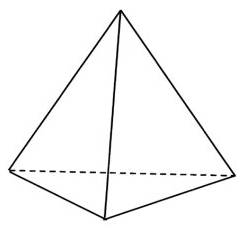 Number of vertices = 4 Number of faces = 4 Number of edges = 6
Number of vertices = 4 Number of faces = 4 Number of edges = 6
Q8. A bulb is kept burning right on the top of a pole. The shadow casted by the pole would look like
Solution
 Light coming from front will cast shadow behind the object.
Q9. Draw a net diagram which when folded gives a cube.
Solution
The net diagram for cube is as below: 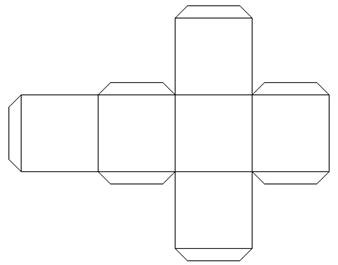
Q10. Name the solid obtained after folding the following net. Also write the number of faces, vertices and edges of this solid. 
Solution
After folding the net the solid obtained is pentagonal prism.
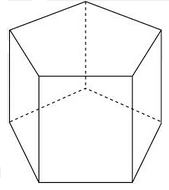 Number of vertices = 10 Number of faces = 7 Number of edges = 15
Number of vertices = 10 Number of faces = 7 Number of edges = 15
Q11. Which of the following cuttings can be used to make a cuboidal box with a top
-
1)

-
2)

-
3)
 w
w
-
4)

Solution
Fold it following the order displayed 
Q12. The top view of the following solid is:

Solution
Circle
Q13. Number of unit cubes in the following solid is:

Solution
Number of unit cubes = 4 x 4 x 4 = 64.
Q14. Draw a cube of edge 2 units on an isometric graph sheet.
Solution
1. First take an isometric graph sheet. 2. Draw the line segment AB, BC of 2 units as length and breadth of cube. 3. For the height draw the line segment AD, BG and CF of 2 units each. 4. Join GF and GD. 5. Again draw EF and ED of 2 units each.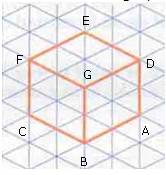
Q15. Two dices are rolled and the faces obtained are 4 and 6. Find the sum of the numbers on their opposite faces. 
Solution
We know that the sum of opposite faces of a die is 7. So the face opposite 4 is 7 - 4 = 3 And the face opposite to 6 is 7 - 6 = 1 Hence the sum of opposite faces = 3 + 1 = 4.
Q16. Count the number of unit cubes in the following solid.
Solution
Number of cubes in the first layer = 5 x 5 = 25 Number of cubes in the second layer = 13 + 4 = 17 Number of cubes in third layer = 4 Hence, total number of cubes = 25 + 17 + 4 = 46
Q17. Draw a cuboid of dimensions 5 units x 2 units x 3 units on an isometric graph sheet.
Solution
1. First take an isometric graph sheet. 2. Draw the line segment AB and AC of length 5 units and 2 units respectively. 3. For the height draw the line segment AG, BF and CD of 3 units each. 4. Join DG and GF. 5. Again draw DE and FE of 5 units and 2 units respectively.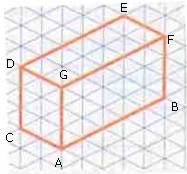
Q18. Count the number of unit cubes in the following shape.
Solution
Number of unit cubes in length is 4. Number of unit cubes in breadth is 4. Number of unit cubes in height is 4. So the total number of cubes is 4 x 4 x 4 = 64.
Q19. Draw three different nets for square pyramid.
Solution
Three different nets for square pyramid are: (i) 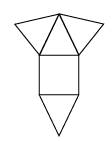 (ii)
(ii) 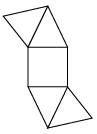 (iii)
(iii) 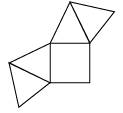
(ii) (iii)
Q20. Draw a cuboid of dimensions 5 units x 3 units x 6 units on an isometric dot sheet.
Solution
1. First take an isometric dot sheet. 2. Draw the line segment AB and AD of length 5 units and 3 units respectively. 3. For the height draw the line segment AG, BC and DE of 6 units each. 4. Join EG and GC. 5. Again draw EF and CF of 5 units and 3 units respectively.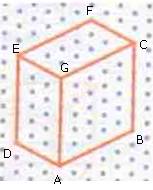
Comments
Post a Comment